Remove home dependency
Host the public portfolio on Cloudflare Pages so normal website availability is independent of the homelab, home power and broadband connection.
Platform Engineering Case Study
A production-style engineering platform combining an externally hosted Cloudflare Pages portfolio with a Git-managed homelab, central monitoring, security engineering and a daily AI log analyst using the OpenAI API.
Current Architecture
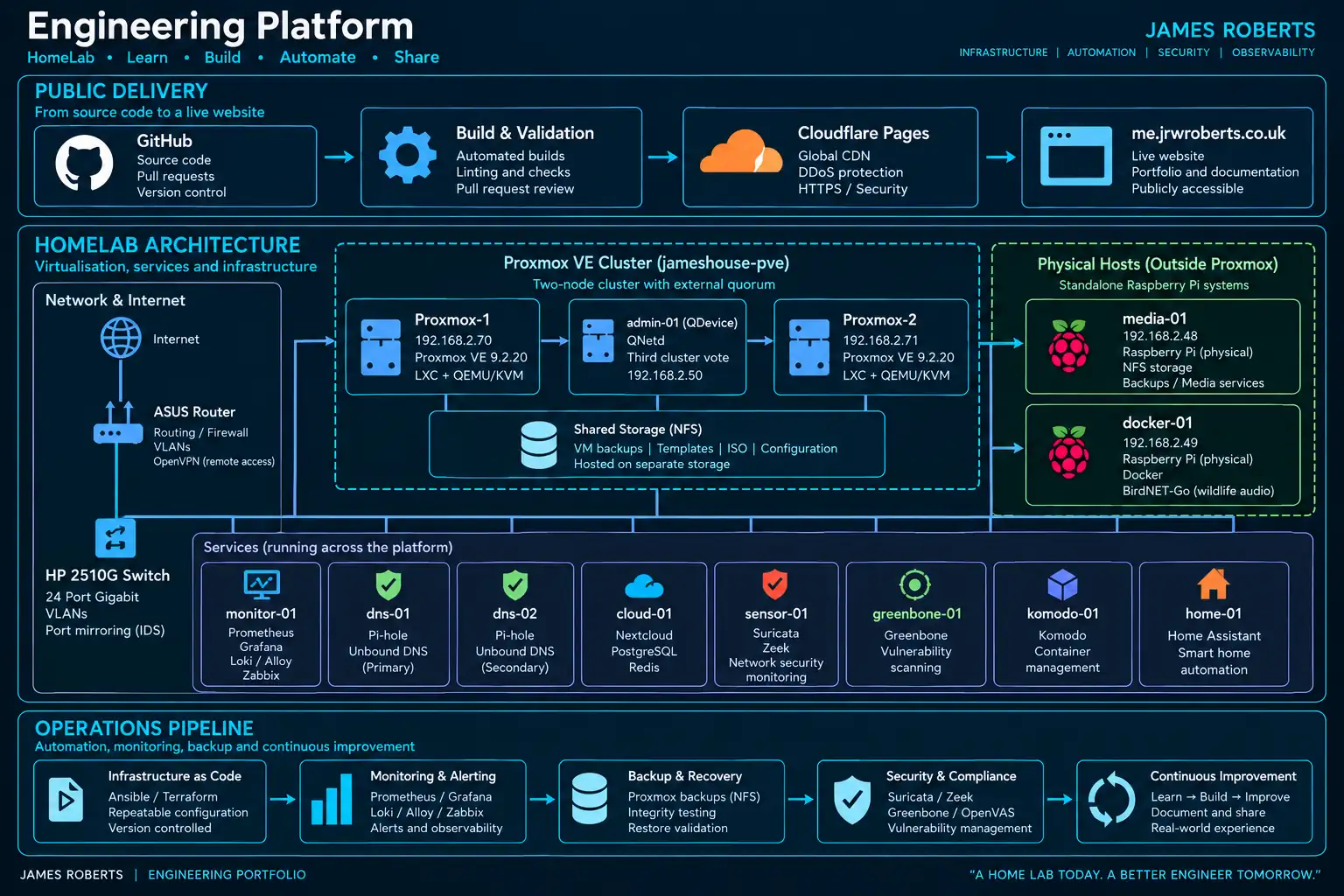
The architecture deliberately separates public availability from home infrastructure while keeping the homelab as a realistic environment for infrastructure, security, observability and automation work.
Executive Summary
The public portfolio began as another workload in the homelab. That worked, but it also meant that a power cut, broadband issue, router change or container outage at home could take the site offline.
I changed the architecture so the public Astro site is delivered by Cloudflare Pages. Git remains the source of truth for the website, and the release path is designed around repeatable build, security and post-deployment validation rather than manual editing in production.
The homelab then becomes what it is better suited to be: a controlled platform for infrastructure engineering, observability, networking, security, automation and recovery work. The same platform also feeds a daily AI log-analysis workflow through the OpenAI API so routine evidence can be condensed into a useful operational review.
The Design Decision
A portfolio should still be available when the infrastructure behind the projects is being upgraded, rebuilt or deliberately broken for learning. External static hosting removes an unnecessary availability dependency without reducing the engineering value of the homelab.
This also creates a useful separation of concerns: Cloudflare Pages serves the public application, while the homelab focuses on compute, DNS, monitoring, cloud services, mail relay, network security and future recovery capabilities.
Project Objectives
Host the public portfolio on Cloudflare Pages so normal website availability is independent of the homelab, home power and broadband connection.
Build the Astro site from Git and move production deployment toward an auditable GitHub Actions workflow with build, security and HTTP validation gates.
Use homelab-platform and its IaC structure as the source of truth for migrated infrastructure instead of relying on historical host names or undocumented state.
Use Prometheus, Grafana, Blackbox monitoring, system logs and service checks to show whether the platform is healthy rather than assuming it is.
Run a scheduled daily log analyst that sends selected operational evidence to the OpenAI API and turns it into a concise review of events, risks and follow-up actions.
Document live services, planned capabilities and retired identities separately so the portfolio reflects the estate that actually exists.
Delivery Approach
The current platform is the result of migration and reconciliation, not a greenfield diagram. Existing services were discovered, validated and then documented or moved deliberately.
Audited the live environment, retired stale identities and documented the real workload placement across Proxmox and physical hosts.
Moved me.jrwroberts.co.uk to Cloudflare Pages so the public portfolio no longer depends on the home lab to remain available.
Made admin-01 the normal controller and homelab-platform/IaC the authoritative path for infrastructure that has been migrated and validated.
Centralised Prometheus, Grafana, Alertmanager and Blackbox monitoring on monitor-01 and expanded health coverage across the estate.
Added a daily analysis path that uses the OpenAI API to turn selected logs and security evidence into a concise operational review.
Continue work on backup and restore proof, sensor capture, central logging, network-host analytics and carefully controlled edge services.
Core Components
Public Web
Source & Delivery
Control Plane
Virtualisation
Core Services
Physical Workloads
Security Engineering
AI Operations
Public Delivery Path
Daily AI Log Analyst
The platform includes a scheduled daily analysis workflow that gathers selected operational and security evidence and submits a controlled digest to the OpenAI API for analysis.
The result is a concise report highlighting unusual activity, notable errors, security-relevant events and suggested areas for follow-up. This gives me a repeatable first-pass review without pretending that an AI summary is itself an incident response decision.
Central Loki and Alloy deployment remains a separate platform workstream; the AI analyst can evolve as the logging architecture becomes more centralised and more service-specific evidence becomes available.
Engineering Challenges
A self-hosted portfolio tied normal website availability to home power, broadband, routing and container infrastructure.
Moved the static public site to Cloudflare Pages while keeping the homelab as the engineering environment behind the portfolio story.
Visitors can reach the portfolio independently of homelab maintenance or outages.
Old identities such as TestServer, DietPi, ids-01 and k3s-node-01 no longer described the real estate.
Reconciled current state, formalised active host roles and retained retired identities only as historical evidence.
Architecture, runbooks and future changes now start from the same current-state model.
Reviewing raw operating-system, service and security logs manually is time consuming and can hide the events that actually deserve attention.
Created a scheduled daily log-analysis workflow using the OpenAI API to summarise selected evidence and highlight significant events and risks.
Routine evidence is condensed into a useful management view while human review remains responsible for action and change decisions.
Planned Cloudflare Tunnel, central logging, SPAN capture and backup capabilities could easily be shown as though they were already operational.
Separated operational, partial, planned and retired states in both documentation and the architecture graphic.
The portfolio demonstrates engineering judgement without overstating the maturity of unfinished capabilities.
Operational Practices
Application and infrastructure changes are version controlled and reviewed before becoming the new documented state.
Build, service health, network reachability and production HTTP checks are used to prove outcomes after change.
Prometheus, Grafana, Alertmanager and Blackbox provide central health and availability evidence.
A scheduled job uses the OpenAI API to summarise selected daily log evidence and highlight items that merit investigation.
Live architecture, future intent and historical evidence are deliberately kept separate to reduce operational ambiguity.
Backup and restore capability is treated as part of service maturity, with unproven recovery called out rather than assumed.
Operational Outcomes
Skills Demonstrated
Lessons Learned
Self-hosting is useful when it adds learning, control or operational value. It is not automatically the best answer for every workload.
Moving the public portfolio to Cloudflare Pages removed a fragile dependency while making the delivery process more cloud-native and easier to validate. The homelab became more useful because it could be changed aggressively without taking the public site with it.
The same principle applies to observability and AI operations: collect evidence first, automate the repetitive parts, and keep human judgement responsible for risk, priority and production change.
Explore the Platform
Explore the other case studies to see how individual capabilities such as monitoring, security, delivery and infrastructure have been built and operated in more detail.